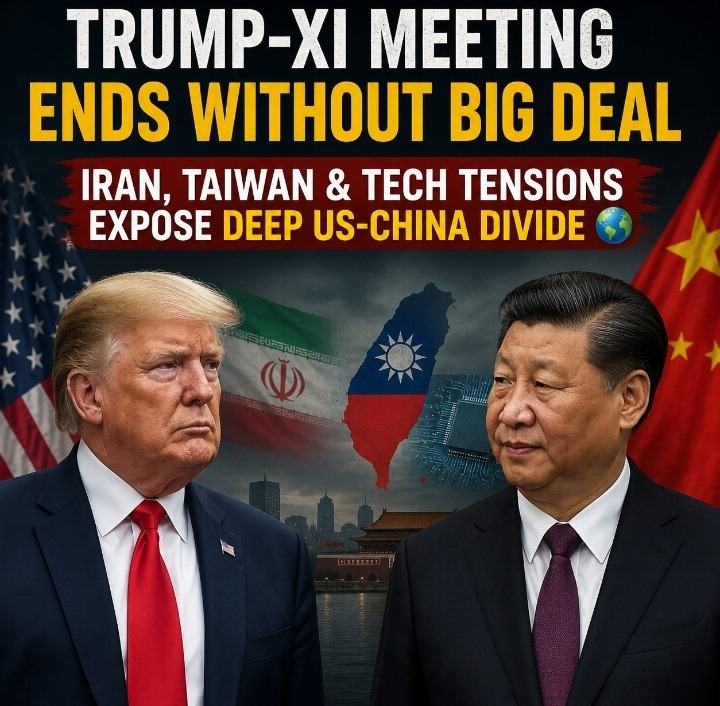
Trump-Xi Beijing Summit Ends Without Major Breakthrough Amid Rising Global Tensions
WASHINGTON: US President Donald Trump’s recent visit to Beijing concluded without the major diplomatic progress many international observers had anticipated, underscoring the growing strategic divide between the United States and China.
During the two-day summit, Trump and Chinese President Xi Jinping displayed a cordial and cooperative tone in public appearances. However, behind the scenes, the discussions reportedly exposed deep disagreements on several sensitive global issues, including Iran, Taiwan, trade policies, and advanced technology competition.
Political analysts had already predicted that expectations for a dramatic improvement in US-China relations were overly optimistic. Experts believe the relationship between the world’s two largest economies has shifted into a more competitive and transactional phase, where both governments prioritize national interests and strategic leverage over long-term compromise.
Although both leaders emphasized the importance of maintaining stable communication channels, the summit failed to produce any major agreements capable of easing tensions between Washington and Beijing. Instead, the meetings highlighted how difficult it has become for both powers to cooperate on complex international matters.
One of the most important topics discussed during the summit was Iran and the growing instability in the Middle East. According to reports from US media outlets, Washington hoped China would use its strong economic relationship with Tehran to encourage restraint and reduce regional tensions.
China remains one of Iran’s largest oil importers and a crucial economic partner, giving Beijing significant influence over the Iranian economy. American officials reportedly believed China could quietly pressure Tehran toward a more moderate approach, potentially lowering the risk of conflict in an already volatile region.
However, there were no clear indications after the summit that Beijing was prepared to fully align itself with US expectations regarding Iran. Chinese officials continued to stress the importance of diplomacy, regional stability, and non-interference in sovereign affairs, maintaining their long-standing foreign policy approach.
Taiwan also remained a sensitive point of disagreement during the discussions. Beijing reiterated its strong opposition to any foreign involvement in Taiwan-related matters, while Washington reaffirmed its strategic commitments in the Indo-Pacific region. The issue continues to be one of the most serious flashpoints in US-China relations.
Technology competition was another major concern dominating the talks. Both countries are locked in an ongoing struggle over semiconductor manufacturing, artificial intelligence, cybersecurity, and global tech influence. Recent restrictions and sanctions imposed by both sides have further intensified tensions within the technology sector.
Despite the lack of concrete achievements, diplomatic observers noted that maintaining direct communication between Trump and Xi was still important for preventing misunderstandings between the two nuclear powers. In today’s increasingly uncertain geopolitical environment, even limited dialogue is considered valuable.
The Beijing summit ultimately reflected the broader reality of modern US-China relations: cooperation where necessary, competition where unavoidable. While neither side appeared interested in open confrontation, the absence of meaningful progress suggested that strategic rivalry between Washington and Beijing is likely to continue shaping global politics for years to come.